

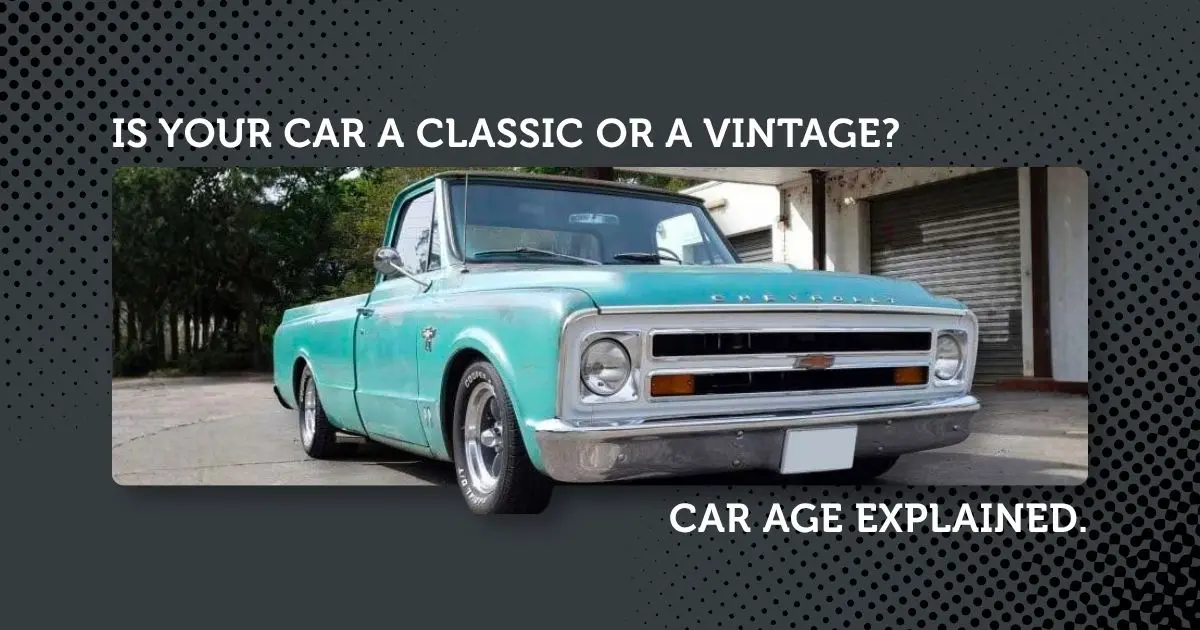
Is Your Car Really a Classic? Car Age Classifications Explained
If you’ve spent time around car enthusiasts, you’ve probably heard debates about what makes a car a “classic”. Some may even call specific models historic or vintage. And while these terms are often used interchangeably, they don’t necessarily mean the same thing.
In Australia, there’s also no single national classification system that neatly places every vehicle into an age category. Definitions can vary between insurers, state and territory registration authorities, motoring organisations, car clubs and car enthusiasts.
So, let’s break down some common terms and what they generally mean.
Modern
This is the simplest category, although even “modern” doesn’t have an official age range. Modern generally refers to newer vehicles that haven’t reached an age commonly associated with classic or historic vehicles.
As vehicles get older, however, the lines can become a little less clear. Some models attract car enthusiast interest well before reaching the age traditionally associated with a classic, which is why people start calling them modern classics.
Modern classic
An informal term often used for cars that are beginning to develop collectable interest but aren’t necessarily old enough to fit traditional ideas of a classic car. They’re often somewhere around 15 to 30 years old, although there’s no official cut-off.
Cars from the 1990s and 2000s are increasingly entering this territory, particularly performance, luxury, rare and limited-production models.
Modern classic isn’t defined by age alone either. Rarity, performance, and demand can upgrade a car to a modern-classic status. In other words, today’s second-hand car could potentially be tomorrow’s collectable.
Classic
This is where things become more complicated. We often hear “classic car” to refer to units around 25 years old or older. However, no universal definition automatically makes every car a “classic” on its 25th birthday.
Different insurers, car clubs and organisations can apply their own definitions and eligibility requirements. The factors that define a modern classic also affect whether people consider a car a genuine classic. That’s why even though two cars manufactured in the same year can still have different levels of collectability.
If you’re unsure how your car should be insured, speaking with a specialist can help you understand your options better. Speak with the Ryno Insurance team or get a quick quote online.
Historic
“Historic” matters in Australia because the term is used in connection with various state and territory concessional registration schemes.
Eligible older vehicles may be registered under special conditions depending on these schemes. However, there’s no universal qualifying age nationwide. Eligibility could start at 25 or 30 years old.
So always check the current requirements with your relevant state or territory transport authority.
Vintage
Here’s where the terminology becomes much more specific. Among motoring organisations, vintage traditionally refers to cars produced during a particular period of early motoring history, generally 1919 to 1930. That’s quite different from how the word is often used in everyday conversation.
Some might call a 1960s or 1970s vehicle “vintage”, for example, simply because it’s old and considered a prized collectable. In traditional motoring terminology, however, vintage refers to a much earlier era. So while that weekend cruiser might be an incredible classic, it isn’t necessarily a vintage.
Veteran
The exact definition can still vary, but cars manufactured before 1919 are generally considered veterans. It’s associated with models from the pioneering years of motoring, when the automobile industry was still developing.
Today, surviving veteran vehicles can represent extraordinary pieces of automotive history.
Antique
“Antique” is another term you may encounter, particularly in overseas publications, advertisements, and car communities. Unlike veteran and vintage, antique isn’t generally as useful when describing a specific Australian motoring era. It’s often used more broadly to describe particularly old or historically significant vehicles.
Not sure where your car fits? We can help.
At Ryno Insurance, we insure vehicles of all ages, from modern prestige and performance cars to classics and enthusiast vehicles. Cars bult before the 1990s are also within our appetite. Our team can help you understand your options and find cover suited to your car and its needs.
You can request a quote online or email us directly at hello@rynoinsurance.com.au to understand your options and find cover suited to your car needs.

Looking for enthusiast car insurance?
Find tailored protection for your ride—explore your options with Ryno Insurance.
Looking for truck insurance?
Shield your truck with coverage that works as hard as you do—discover the options with Ryno Insurance.